Authentic Innovators

Who are we?
Meet our team of innovators.
Gabriel F.
Gabriel here. Student, creative, lover, poet. Here to hone my craft in the sphere of digitality. In my free time I enjoy reading; a lost art in our generation and one I take pride in. My intellectual interests fall in the world of critical theoretics. Post-Nietzschean Futurism is my current passion. I would list some of my favourite musicians but aside from the great classical composers you wouldn't know any of them.
Michael A.
My name is Michael. I am a second-year mech eng student and am looking to develop my “soft” skills in this course. As an avid gamer myself, studying how we navigate digital interfaces is very intriguing. Not everyone understands how difficult it is to code and develop software, which is something I am dabbling in myself. I hope to bridge the connection between online and reality in this course. My favourite show is “The Boys” and my favourite movie is “American Psycho”. I like listening to “Radiohead” and “Weezer”.
Daniel.C
Yo, it’s me Dan. I’m a third year business student and this is my elective course this semester. I like to hang out with my boys and this project is really taking away from that. I like basketball and volleyball but I play a lot of hockey.
Week 1: The Cyborg Manifesto
By: Gabriel F.
Donna J. Haraway’s landmark essay “A Cyborg Manifesto” explores the social implications and imaginative potential of the “cyborg”. Rooted in a post-structuralist ideology that problematizes dichotomies (ex. man/woman, human/ machine) which are seen as natural truths, Haraway argues for us to recognize the futility in melding these often incompatible opposites. In escaping this dichotomy, Haraway centers the cyborg, which is the center of the so-called “social feminist faith”. She defines the cyborg as an amalgamation of humans and machines, which functions as a model for a new form of consciousness and political activism. A cyborg, therefore, is a signal of the tangible future where the yoke of conformity and ideology are overthrown.
Haraway sees the male, white, capitalist world as one composed of rigid binaries: man/woman, human/animal, online/offline, and the list goes on. Feminism, furthermore, is also reliant on these boundaries as it relies on assumptions about “natural” or “essential” female identities. A cyborg, by nature, opposes these binaries, and compels us to look beyond them, as it is a creature of a post-gender world. Embracing the cyborg exhibits a way to resist patriarchy and colonialism, which are maintained through the policing of boundaries that the cyborg inherently opposes. The cyborg is by nature anti-essentialist, which allows humans a way to challenge identities that are assumed to be innate or inherited.
A cyborg has no origin story, like a human’s “Genesis” in the Garden of Eden. This cyborg imagined by Haraway is not formed by any man. Instead, the cyborg emerges outside of the teleological binaries of creation and destruction. A cyborg represents unity without being a totality, and has the potential to traverse and meld both the world of “reality” and “fiction”. While a cyborg is not born, it is the “illegitimate offspring” of the structures of the militaristic and capitalistic world from which it is created, and is unfaithful to their origins.
Haraway establishes three breaches of boundaries that occurred at the end of the 20th century which makes this theory possible:
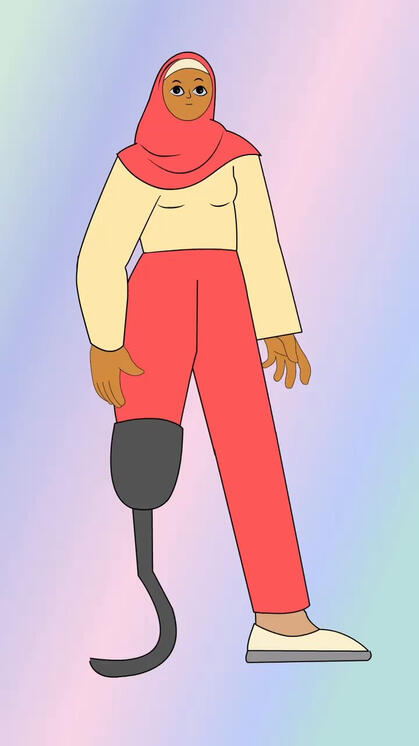
A person with a prosthetic leg.
Animal/Human
Animal rights activists have breached the boundaries of human and non-human, in turn with many branches of feminism that affirm the connection between humans and other living creatures. Language, tool usage, and social behavior were recognized as not unique to humans, prompting movements closing the breach between humans and the natural world.
Human/Machine
Machines before the late 20th century were not self-moving or autonomous. Today, machines can resemble lifelike qualities. Therefore, the boundaries between natural and artificial, mind and body, become unfixed and questioned. Machines today are uncannily animated and have the capacity to assume typically human characteristics, namely Artificial Intelligence.
Physical/Non-Physical
Haraway sees modern machines as practically invisible. They can exist everywhere simultaneously, blurring the boundaries between what is real and what is not.
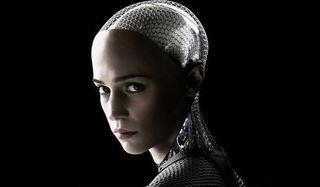
Ava, a robot from the movie Ex Machina.
Haraway asserts that cyborgs exist in our current world, and are not a far-fetched ideal of the future or bounded within science fiction narratives. Many individuals rely on prostheses, such as glasses or prosthetic limbs. We would struggle to go throughout the day without relying on a separate tool yet an extension of ourselves formed through an artificial nexus between humans and machines. According to Haraway, in navigating a world through tools and machines extraneous yet intertwined within us we become this hybrid figure. If one were to postulate further, relying on our cell phones as an “extra limb” or writing using generative AI would further demonstrate that the majority of us have become these hybrid entities Haraway imagines.
In the media, cyborg entities have made us contemplate the boundaries of human and non-human, machine and mind. Haraway sees this contemplation as futile, as this boundary is purely hypothetical. In conclusion, what makes Haraway’s theory culturally resonant is the possibility that the cyborg is more human than us.
Week 2: The Persistence of Visual Knowledge
By: Gabriel F.
Materializing the Immaterial